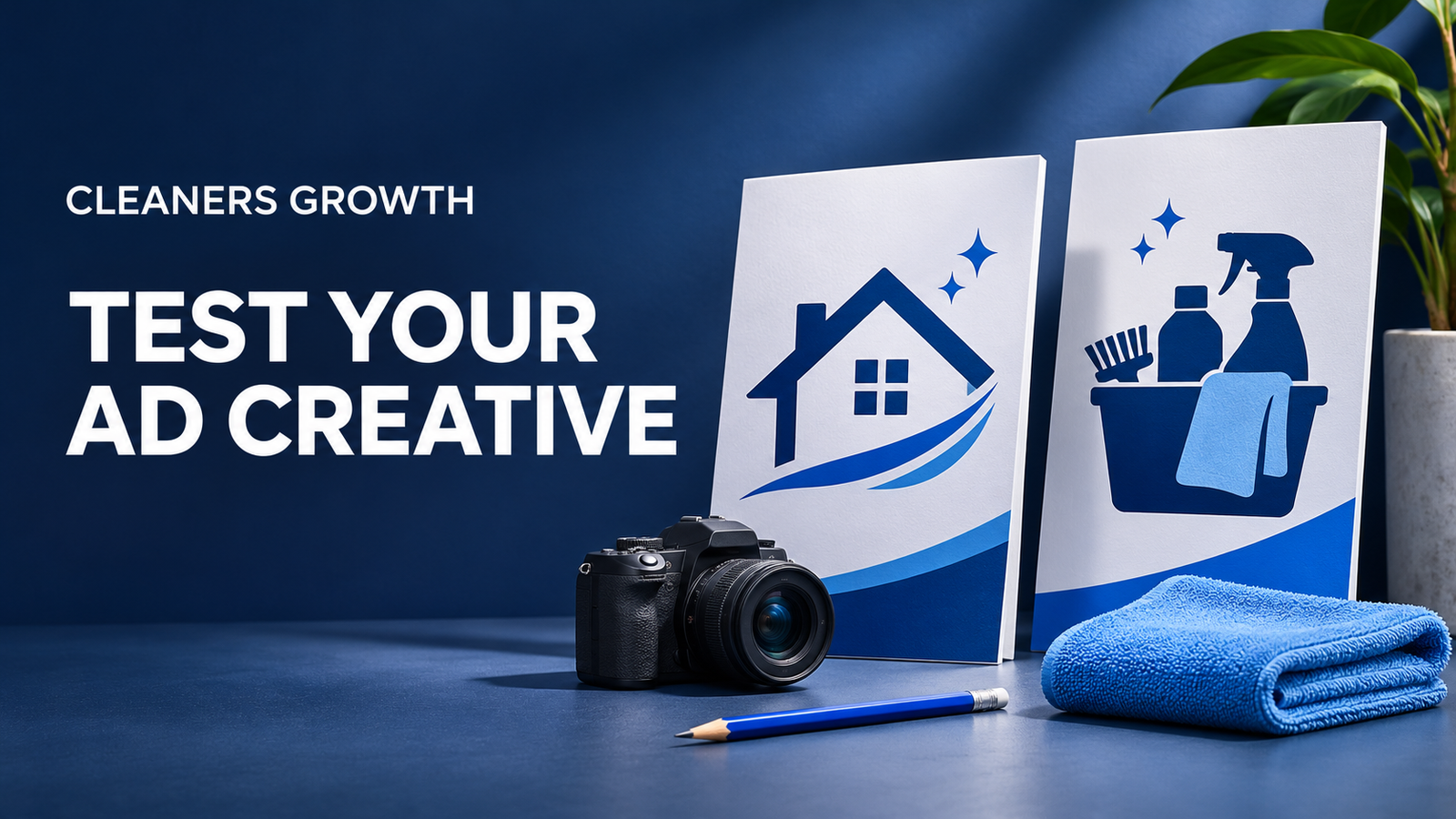
Meta ads creative for cleaning businesses needs to do more than attract attention. It should help the right person recognize the service, understand the next step, and decide whether to request an estimate.
A polished image can still create the wrong expectations. A commercial prospect may interpret a house-cleaning visual as irrelevant. A homeowner may click an attractive transformation video without understanding which service the company offers or where it operates.
A practical testing plan starts with a business question, produces a manageable set of creative options, and evaluates the inquiries that follow. This guide focuses on planning and comparing the ad itself, rather than changing your instant form or rebuilding your campaign structure.
1. Define one service and one customer situation
Write a short creative brief before opening a design tool. Specify the service you can deliver, the market you serve, the customer situation, and the action you want the prospect to take.
For recurring residential cleaning, the situation might be a household considering ongoing help. For janitorial services, it might be a facility contact looking for a provider and a walkthrough. Carpet, window, pressure washing, and post-construction campaigns need their own service context.
Keep the brief specific enough to guide the creative. “Get cleaning leads” does not help a designer decide what property, work, or message to show.
Include the real next step. An estimate request is different from an immediate booking, and a commercial walkthrough is different from accepting a contract. The visual and copy should support the process your office actually follows.
2. Turn the brief into a testable question
A useful question identifies what you want to learn. For example: “Does showing our team at work generate more suitable recurring-cleaning inquiries than showing a finished room, when the message and offer stay the same?”
That is more useful than “Which ad looks better?” It connects the visual choice to a business outcome while keeping the comparison understandable.
Use the following illustrative planning ideas as starting points, not claims about which creative will win.
| Question | Creative variable | Keep consistent |
|---|---|---|
| Do prospects respond better to people or the finished space? | Team-at-work image versus completed-room image. | Copy, offer, destination, and intended audience. |
| Which message makes the service easier to understand? | The opening sentence. | Image, service, next step, and destination. |
| Does a clear scope explanation help attract suitable requests? | A specific service explanation versus a more general explanation. | Visual, geographic coverage, and request process. |
Start with a question that matters to your current inquiries. If prospects repeatedly mistake your offer for employment, test service clarity before spending time comparing decorative colors.
3. Gather assets that represent your actual service
Build a small asset library with approved photos, short clips, descriptions, and permission records. Organize it by service and setting so a designer does not accidentally use a residential photo to represent commercial work.
When capturing material, plan for clear subject matter: a team preparing for a job, an appropriate cleaning task, a finished space, or the equipment relevant to the service. Keep the scene understandable without a long caption.
Protect customer details. Remove visible addresses, documents, access codes, family photos, or other identifying information before using a property image. Confirm permission for identifiable people and premises.
Keep evidence and illustration separate
A stock or generated image can illustrate an idea, but it should not be presented as a completed client job or a real employee. Likewise, do not create a fictional testimonial, certification, or performance badge to make the ad appear more persuasive.
If you use before-and-after material, preserve honest context. Do not pair unrelated rooms or manipulate the images to imply a result that did not occur. Label the actual service accurately instead of making a broad promise from one example.
4. Write copy that qualifies the request
The opening line should make the service recognizable. The remaining copy should give enough context to help a suitable prospect take the next step.
A practical message structure is:
- Service: What cleaning work you provide.
- Coverage: Where the offer applies, stated accurately.
- Useful detail: A verified part of the service or estimate process.
- Action: What the person can request next.
For illustration, a residential message could say: “Looking for recurring house cleaning in our service area? Tell us about your home and preferred schedule to request an estimate.” Replace the coverage and process with your actual details.
A commercial message might invite a facility contact to discuss janitorial requirements and arrange a walkthrough. It should not imply an instant fixed quote if the company needs to assess the property first.
Use prices, discounts, guarantees, or availability statements only when they are real and the relevant conditions can be explained. Avoid a dramatic promise that the estimate process immediately contradicts.
5. Preview the complete ad experience
Review the image, copy, headline, action button, and destination together. The audience encounters one experience, even if different people produced its parts.
Check the previews for the placements you intend to use. Make sure important wording and the subject remain readable after cropping. A layout that works in one shape may need a separate version for another placement.
For video, confirm that the opening makes sense, essential information is understandable without relying entirely on audio, and any captions accurately reflect the content. Avoid shrinking a long sales pitch into tiny text.
Open the destination on a phone. If the ad promotes recurring cleaning but the destination only explains one-time deep cleans, the creative comparison will also reflect that mismatch.
For instant forms, review the introduction and completion message as well. Our Meta lead ads quality checklist covers that separate part of the journey in more detail.
6. Choose an appropriate comparison method
Meta’s A/B testing guidance describes testing one variable while keeping the rest consistent. Its testing tool separates audiences into randomized, non-overlapping groups to make comparisons more reliable.
The same guidance explains why simply running different ads or ad sets at the same time is not equivalent to a controlled experiment: delivery and budget distribution can differ.
Decide whether you need a formal A/B test or an exploratory creative comparison, and label the result accordingly. Review the available setup with your campaign manager before launching.
If you change the image, copy, offer, and destination together, you may learn which overall package performs better. You will not have isolated which individual element caused the difference.
Plan the review before the test starts
Record the question, variants, main outcome, planned spending, review period, and reasons you would stop early, such as a broken link or incorrect service claim. Choose a plan the business can afford to complete.
Do not promise that every test will produce a clear winner. Limited data, uneven business demand, and a long sales cycle can leave a comparison inconclusive. Keep that result visible rather than forcing a confident conclusion.
7. Evaluate inquiry quality alongside platform results
Attention and clicks can help diagnose an ad, but the final review should include the opportunities your office receives. Use consistent definitions for genuine inquiries, qualified requests, estimates or walkthroughs, and booked jobs.
Keep the creative identifier with the lead record when your integration supports it. Confirm that the identifier is actually saved before expecting the office to report by creative version.
Compare outcomes from the same group of inquiries over an appropriate period. A commercial prospect may still be reviewing a proposal when a residential prospect has already booked. Calling the first creative unsuccessful immediately would overlook that timing.
Look for patterns rather than isolated stories. One unusual inquiry is useful context, but it does not establish that every person responding to that ad shares the same intent.
If a version attracts cheaper inquiries but many are outside your service scope, record that tradeoff. If a version attracts suitable requests that do not receive a response, investigate the handoff before blaming the creative.
8. Keep a creative learning log
Store the approved asset, exact copy, destination, campaign identifier, test question, dates, and review notes together. Add the decision: continue, revise, stop, or gather more evidence.
Describe what you observed without overstating the conclusion. “This version generated more qualified requests during the review period” is different from “This image always works for cleaning companies.”
Use the log to plan the next question. If showing the service clearly helped, the next test might explore a different opening line while preserving that clarity. Avoid making fresh creative by repeatedly changing details without a documented reason.
Frequently asked questions
Should I test images or copy first?
Start with the uncertainty most likely to affect the customer’s understanding. If the service is unclear, address that. If the message is accurate but the visual does not represent the work, test the visual.
Does a lower cost per lead prove the creative is better?
No. Review service fit, qualification, and bookings as well as the platform metric. Make sure both versions use the same outcome definitions.
How often should I replace cleaning ad creative?
Use performance evidence, changing offers, service accuracy, and a clear new question to guide updates. There is no single replacement schedule that fits every cleaning business.
Give the next creative test a clear purpose
Choose one service, write one useful question, and prepare a comparison your team can explain. Verify the destination and lead records before evaluating the result.
Cleaners Growth supports US cleaning companies with Meta Ads campaign management and creative guidance and conversion tracking for calls and quote requests. Request the Free Leak Finder Audit for a focused review of gaps in your ads, website, or tracking.